
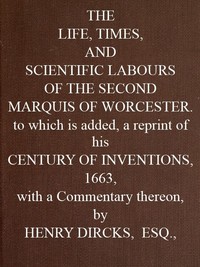
The Life, Times, and Scientific Labours of the Second Marquis of Worcester
This isn't your typical biography of a lord or a scientist. It's a rescue mission. Henry Dircks, a Victorian engineer himself, became obsessed with the story of Edward Somerset, the Second Marquis of Worcester (1601-1667). During the chaotic English Civil War and Restoration, Worcester wasn't just a nobleman; he was a tinkerer and inventor who published a list of 100 incredible machines he claimed to have built or designed.
The Story
The book follows two parallel tracks. First, it traces Worcester's dramatic life: his vast wealth, his loyalty to the King during the Civil War, his financial ruin, and his eventual imprisonment in the Tower of London where he died. Woven through this political saga is his lifelong passion for mechanics. His famous book, 'A Century of Inventions,' describes devices ranging from a primitive calculating machine to a detailed plan for a 'water-commanding engine'—what Dircks argues is a genuine steam engine. The central mystery is: were these just ideas on paper, or did he actually build working models? After his death, his work was largely ignored or dismissed, and credit for the steam engine's development went to later figures like Thomas Savery and James Watt.
Why You Should Read It
What makes this book compelling is Dircks's passion. He's not a detached historian; he's an advocate. You can feel his frustration as he sifts through incomplete records and battles against the established narrative. He presents Worcester as a tragic, misunderstood figure, a practical genius whose contributions were lost in the turmoil of his times. Reading it, you become a partner in this historical investigation, weighing the evidence Dircks piles up: sketches, contemporary accounts, and technical analysis. It makes you question how history gets written and who gets remembered.
Final Verdict
This is a niche book, but a fascinating one. It's perfect for history buffs who enjoy 'what-if' scenarios, fans of stories about obscure inventors, or anyone who likes a good historical detective story. Be warned, it's a 19th-century text, so the writing can be dense in places, and Dircks's arguments are very one-sided. But that's part of the charm. You're not getting a sterile, balanced textbook account; you're getting a passionate, century-old plea for justice for a forgotten marquis and his marvelous machines. If that idea intrigues you, dive in.
This content is free to share and distribute. You do not need permission to reproduce this work.
George Robinson
1 year agoIf you enjoy this genre, the flow of the text seems very fluid. Exactly what I needed.






William Martinez
3 months agoHaving explored several resources on this, I find that the concise summaries at the end of each section are a lifesaver. This has become my go-to guide for this specific topic.