
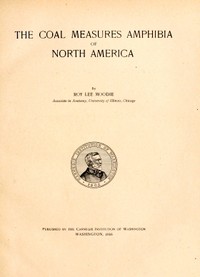
The Coal Measures Amphibia of North America by Roy Lee Moodie
Okay, let's be clear from the start: 'The Coal Measures Amphibia of North America' is not a beach read. Published in 1916, it's a technical monograph written by paleontologist Roy Lee Moodie for other scientists. But if you can push through the old-fashioned academic language, you find a fascinating story being told through bone fragments and rock layers.
The Story
There isn't a plot in the traditional sense. Instead, Moodie acts as a guide through a lost world. The 'story' is his scientific investigation into the giant salamander-like creatures that lived during the Carboniferous period, long before dinosaurs. These animals, with names like Eryops and Diplocaulus, left their fossils in the layers of rock we now mine for coal. Moodie meticulously describes their skeletons, debates how they moved on land and in water, and tries to picture their vanished ecosystems—lush, oxygen-rich swamps that covered parts of North America. The narrative is the slow, careful work of reconstructing a world from its shattered remains.
Why You Should Read It
You should read it for the sense of discovery. Moodie's passion is evident. He's not just cataloging bones; he's solving puzzles. How did that weird, boomerang-shaped skull function? What do these trackways tell us about their social behavior? Reading it, you get a front-row seat to the early days of American paleontology. It’s humbling to realize that the ground beneath our feet was once a sprawling, humid jungle teeming with these ancient life forms. The book connects the dots between the fossil in a museum, the coal in your power plant, and a profoundly different planet.
Final Verdict
This book is a specialized tool, not for everyone. It's perfect for history of science nerds, amateur paleontology enthusiasts, or anyone with a deep curiosity about North America's prehistoric past. If you love the idea of 'primary source' material and watching a scientist think on the page, you'll find it rewarding. For the casual reader, it might be too dry. But if you've ever looked at the Appalachian Mountains and wondered what secrets they hold, Moodie's work offers a profound, if challenging, answer.
You are viewing a work that belongs to the global public domain. It serves as a testament to our shared literary heritage.
George Thomas
2 months agoFrom a researcher's perspective, the transition between theoretical knowledge and practical application is seamless. Simple, effective, and authoritative – what else could you ask for?
Emily Martinez
7 months agoI stumbled upon this title and the author's voice is distinct and makes complex topics easy to digest. Exactly what I needed.






Jessica Harris
11 months agoI started reading this with a critical mind, the footnotes provide extra depth for those who want to dig deeper. It’s hard to find this much value in a single source these days.