
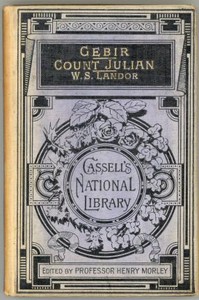
Gebir, and Count Julian by Walter Savage Landor
Walter Savage Landor is one of those names you might skim past in a literary anthology. He was a contemporary of Wordsworth and Shelley, but he never quite hit their fame. 'Gebir, and Count Julian' shows you why he deserves a second look, and also why he's been mostly forgotten. It's a book of two intense, dramatic poems that feel like they're from another age entirely.
The Story
'Gebir' is a seven-book epic that starts with a simple premise: Gebir, a Spanish prince, invades Africa to conquer it. But he quickly gets tangled in a world of ancient magic. He falls for Charoba, the queen of a hidden, advanced civilization, while his own brother gets ensnared by a vengeful sea nymph. It's a swirl of love, betrayal, and supernatural forces, all leading to a tragic end. 'Count Julian' is tighter and more devastating. It's based on the real story of a Spanish nobleman who, to avenge a personal wrong against his daughter, helps the Moors invade and conquer Spain in the 8th century. The poem digs into his torment, his single-minded rage, and the catastrophic national consequences of his personal grief.
Why You Should Read It
You read this for the moments, not necessarily the smooth ride. Landor's imagination is spectacular. In 'Gebir', he describes a submerged, glittering city that took my breath away. In 'Count Julian', the psychological portrait of a man eaten alive by hatred is painfully sharp. His language can be incredibly powerful—lush, rhythmic, and forceful. But be ready to work for it. He assumes you know your Greek myths and Roman history, and his syntax can tie itself in knots. It's like listening to a brilliant, slightly cranky professor who occasionally speaks in pure, clear poetry.
Final Verdict
This isn't for everyone. If you want a straightforward narrative, look elsewhere. But if you're a patient reader who loves the Romantic era, or if you're curious about the strange, ambitious paths poetry took beyond the famous names, Landor is a rewarding discovery. Perfect for history buffs who like their drama poetic, or for poetry fans willing to wrestle with a challenging, grandiose text. Think of it as a literary excavation site—you'll get dusty and scratch your head sometimes, but you might just uncover a forgotten treasure.
This publication is available for unrestricted use. Knowledge should be free and accessible.
Paul Hernandez
2 months agoMy first impression was quite positive because the evidence-based approach makes it a very credible source of information. An excellent example of how quality digital books should be formatted.
Linda Taylor
8 months agoFrom a researcher's perspective, the objective evaluation of the pros and cons is very refreshing. The price-to-value ratio here is simply unbeatable.
Patricia Rodriguez
1 year agoThe information is current and very relevant to today's needs.
Kimberly Anderson
3 months agoHaving read the author's previous works, the wealth of information provided exceeds the average market standard. A rare gem in a sea of mediocre content.
Christopher White
1 year agoI was particularly interested in the case studies mentioned here, the argument presented in the middle section is particularly compelling. This has become my go-to guide for this specific topic.