
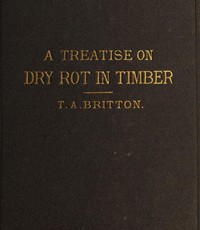
A treatise on the origin, progress, prevention, and cure of dry rot in timber…
Published in 1815, Thomas Allen Britton's A Treatise on the Origin, Progress, Prevention, and Cure of Dry Rot in Timber is exactly what the title promises, but it's delivered with the fervor of a public health crusade. Forget a dry technical manual; this is a passionate investigation into a problem threatening to literally bring down the structures of British society.
The Story
Britton lays out his case like a prosecutor. He first introduces the 'villain': dry rot, a fungal decay that turns solid timber into brittle, crumbly dust. He tracks its 'origins'—often damp, poorly ventilated spaces—and details its 'progress,' how it spreads unseen behind walls and under floors. The heart of the book is his tour of the crime scene. He points to famous victims: the dome of St. Paul's Cathedral, the ships of the Royal Navy, countless country estates. Each example is a story of neglect and costly ruin. Finally, he shifts to the solution, offering detailed plans for 'prevention and cure.' This isn't just advice; it's a manifesto for better building practices, from choosing the right wood to designing cellars that actually breathe.
Why You Should Read It
You should read it for Britton's voice. He's genuinely alarmed and wants you to be, too. His writing transforms a niche architectural issue into a tangible threat. You get a real sense of how people in the early 1800s understood (and misunderstood) their material world. It's also unintentionally funny at times, especially when Britton vents his frustration at the 'careless ignorance' of builders and homeowners who let moisture run rampant. More than a guide, it's a snapshot of a society grappling with the decay of its own infrastructure, told by a wonderfully opinionated expert.
Final Verdict
This is a niche gem, but a brilliant one. It's perfect for history buffs who love primary sources, old-house owners with a sense of humor, or anyone fascinated by the hidden dramas of everyday things. You won't get a novel's plot or characters, but you will get a compelling argument from a man fighting a crumbling war on behalf of good timber. It’s a short, surprising, and oddly human look at a problem we still face today, just with better sealants.
This work has been identified as being free of known copyright restrictions. Distribute this work to help spread literacy.
Michael Thomas
9 months agoAfter a thorough walkthrough of the table of contents, the insights into future trends are particularly thought-provoking. If you want to master this topic, start right here.
Jennifer Garcia
1 year agoThought-provoking and well-organized content.
Joseph White
1 year agoIt’s refreshing to see such a high standard of digital publishing.
Sandra Martinez
1 year agoThis is one of those stories where the emotional weight of the story is balanced perfectly. Truly inspiring.







Matthew Rodriguez
2 years agoGiven the current trends in this field, the footnotes provide extra depth for those who want to dig deeper. I'll be citing this in my upcoming project.